The Barber Lounge’s Closure

COVID-19 causes business to temporarily close.

Barber Lounge in Richmond closed due to COVID-19, could lead to permanent closure.

COVID-19 has negatively affected the world in many ways. One of the most prominent is the closure of many businesses. The only stores that are allowed to be open are ones like grocery stores and stores where people can get essential supplies. Any other business that isn’t that is deemed “non-essential” and must be closed. While this has been the way to reduce the amount of people that get infected, many people have become unemployed. 

Those who have been affected most are small businesses, from the workers to the managers themselves. Small businesses aren’t like large corporations so being closed for so long will have long term effects on them.

The Barber Lounge is located in Richmond, California. The shop is located on one of Ricmond’s most busy streets, 23rd St. The shop would always be full with appointments as well as walk-ins. But since the stay and home order, the shop had to close to abide by the order.

The shop is run by Juvenal Virruete, as well as his younger brother, Alejandro Virruete when Juvenal isn’t around. The brothers decided to have their own shop since they are in control of the hours that they work and it makes them a good income. 

The shop opened up back in 2015. And with about seven to eight barbers working at the shop, The Barber Lounge always had many clients coming in for haircuts.

“It was one of the newest barber shops so everybody wanted to try it out. And we were full, we were fully staffed. Everybody was there, all the chairs were picked up and everyone has the clientele, you know? It was popping,” Alejandro Virruete said.

That came to a stop on March 13 when the shop had to close. Juvenal Virruete would get $170 each week from the barbers in order to pay for the rent but he has not gotten that but that does not mean that the shop’s rent won’t be paid. 

Alejandro Virruete had made the decision to start cutting hair from home since barbers aren’t able to do haircuts at The Barber Lounge. Instead of charging $30 per haircut, he has raised his price to $40. Virruete does have requirements for those who do decide to get a haircut during the pandemic.

“Come clean; showered. Wear a face mask, I mean, might as well take precaution. I don’t let people use the bathroom at my house, just come by yourself,” Virruete said. 

“It has been successful but not like how it used to… I’m not getting walk-ins, I’m not getting a lot of people coming in. So I advertise on Instagram and that’s how I get some people but walk-ins, people passing by, driving by, I don’t get that,” Virruete later added.

Even though the stay at home order is still in place, The Barber Lounge “opened” on Tuesday, May 5. The only clients that are getting haircuts are family and friends of the barbers since the shop is not supposed to be open at all.

“I cannot afford it, I cannot afford that they come in and give me a fine,” Juvenal Virruete said. 

Virruete explained that he thinks agents from the California Board of Barbering and Cosmetology could come to give him a penalty on his license.

Unfortunately, like many business owners, Juvenal Virruete is unsure how he will pay the rent for next month. 

“… My landlord is not going to wait, you know? Because he’s also buying the building, he got a mortgage to pay too,” Juvenal Virruete said.

Juvenal Virruete at this time has applied for the SBA’s Disaster Loan Assistance. After four weeks, his application has not progressed, he has received an email that confirms that he submitted the application with a confirmation number. Virruete got a second email after that apologized and thanked Virruete for being patient. He may have to wait another five to six weeks to know if he will be approved for the loan.

“I hope this month goes fast and they reopen because if they keep extending it, I’m gonna lose everything, I’m gonna lose all my business, all my income. I’m gonna lose everything, everything that I’ve worked for, for the last five years…,” Juvenal Virruete later added. 

Emigrating from Central America

Salvadoran civil war continues to affect its citizens.

The Central American caravan comes to the United States to escape dangers of their homeland.

The Salvadoran civil war began in 1980 and ended by the early to mid 1990s. Just because the war ended does not mean it did not have lasting effects towards its people. Especially to those that were born during the time of the civil war.

Aida Villalta was one of those that was born during the war and experienced it first hand. 

“When I was 12 the war was almost done… I saw everything, I saw dead bodies almost my whole life. When they killed people they would stick the head in a post and the body was all over the places… ”

Villalta was one who saw it all first hand, as parts of her family were involved in the war.

“My dad had family in the guerrilleros and my mom had family in the military.”

“After the war, it became unsafe because there were a lot of people stealing and a lot of crime and a lot of killing people, kidnapping people… It was maybe worse than the war itself,” Villalta continued. 

Even though the war ended when she was a little girl, Villalta still experienced danger as a young adult. She had many experiences that related to stealing.

“I was wearing one of the necklaces that my mom sent me… it was a very thin necklace, it was gold or silver I can’t remember, and I was wearing it, I forgot to take it off. When I was at the bus stop a guy came to me with a knife and said ‘take it off and give it to me or else’… An old man came and stood between me and him and I pushed the guy against the thief and ran and got on the bus.”

Villalta arrived in the United States in 1997 to get a better life and escape the dangers that she was facing in El Salvador.

It can be seen on the data table of Refugees and Asylees 2018, that can be accessed on the Department of Homeland Security website, that between 1989 to 1995, more than 100,000 refugees sought refuge in the United States each year. That being around the time where Salvadorans were coming to the United States to seek refuge. 

The table below shows the increase of Salvadorans that sought refuge that came in 2017 versus 2016. The numbers jump from 364 to 1,124. The numbers do go down in 2018 to 725 but that number is still high.

While the numbers don’t compare to the tens of thousands of refugees that came to the United States in the early 1990s, it shows they are still seeking to find a better life somewhere that isn’t their home country.

But Villalta is someone that feels that immigrants should stop coming to the United States, it’s not worth it.

“In here, it was good to make money years ago but now it’s like, I don’t know, it’s hard to even survive.”

Crime in North Beach

Theft is the most prominent crime in North Beach.

While North Beach looks to be safe and sound, crime does not stop.

The North Beach neighborhood in San Francisco is one of the many areas visited by tourists. For places such as Coit Tower and Pier 39, the area seems to be one of the nicest but it is no stranger to crime. 

While “violent” crimes aren’t prominent in the neighborhood, the great majority of crimes that occur in the area have to do with theft.

Larceny theft is the most reported crime to Central Station, the closest station to North Beach as well as its neighboring areas like China Town, Russian Hill and Telegraph Hill. Almost half of the thefts are classified as car thefts alone.

Henry Jeger has been living in the neighborhood for the last 12 years and says that he, as well as his neighbors, have personally experienced theft in their everyday lives. 

“Because of a concern over crime and theft we had a camera set up at our security gate. After the camera was installed I had a package that was delivered and I received a notification from the service and about two to three hours when I came home, inside the security gate was an open box with my items gone,” Jeger stated.

“So we looked at the film and what happened was a couple of guys sat down, they were able to reach in and grab the box that was close to the security gate and they cut it open with a knife cutter and took out my jacket and put in a big shopping bag, somewhat similar to a Trader Joe’s bag and walked away,” Jeger stated.

Jeger later stated that he is someone that is home more than other neighbors so he will pick up their packages and keep them safe at his house until they get home.

I have a neighbor who was parked in front of a house that sold for an awful lot of money up the street, not long ago. He had his van parked up there for three days, he went to get it and it was gone. So someone stole it right in front of a very expensive house,” Jeger later added.

Adam Lobsinger, a Public Information Officer, made some suggestions for residents as to how they can protect themselves from experiencing theft.

“Never leave valuables in view. Place items in your trunk prior to arriving at your destination. Keep all items such as backpacks, purses, cameras and passports on your person. Park in a lot with an attendant, if possible. Keep packages with you until you’re ready to leave or move your vehicle to a different location each time you load items into the trunk,” Lobsinger stated via email.

While theft is not seen as a huge crime, it is still important to take caution in order to not experience it first hand.

COVID-19 affects San Francisco

Tourist locations in San Francisco closed due to COVID-19.

Museums and multiple other tourist locations in San Francisco have closed due to COVID-19 till the end of March.

 The Academy of Sciences, SFMOMA, Exploratorium, Legion of Honor and other museums in San Francisco have all closed since March 14 due to the executive order from Gavin Newsom  and recommendations of health officials of the State of California to cancel gatherings of 250 people and more.

Mayor London Breed announced on March 13 that the Health Officer of the City and County of San Francisco have issued a Public Health Order that prohibits all non-essential events of 100 or more persons. The order will stay in effect until April 30.

The order has affected the people who work in museums and tourist spots as they are now prohibited from coming in to work. 

Angel Stewart is an associate at the Academy Stores in the Academy of Sciences and has been affected by its closure.

“I can’t go to work for two weeks which means no money! Which sucks because I have upcoming bills due,” Stewart said.

Others have not entirely been affected by the actions of the virus. David Vuong is a sales lead at the Academy Stores that has also been banned from coming into work. He was asked if COVID-19 has affected him.

“Other than stopping my primary source of income temporarily, not badly. I still attend classes online and I have a lot of free time currently,” Vuong said.

It has gone as far that those who are no longer working are now allowed to apply for unemployment for the time being until they are able to return to work.

Places like the Academy of Sciences have stated that they will remain closed to the public until March 31 but that will likely be extended due to the Public Health Order set by Mayor Breed.

As of March 16, San Francisco County, among many other counties in the Bay Area, have announced that they will be on lockdown for the next three weeks. Residents are prohibited from leaving their homes except from buying essentials at grocery stores or going to the doctors.

Board of Supervisors Meeting

Special Order made at Board of Supervisors meeting for recognition of commendations in honoring Women’s History Month on March 3.

March is Women’s History Month and in celebration of that, at the Board of Supervisors meeting, each supervisor of San Francisco recognized a woman that they felt should be honored for their hard work and love for their community.

The women awarded were Wendolyn Aragón, Windy Click, Christin Evans, Nicole Termini Germain, Theresa Kolish, Hong Mei Pang, Susan Pferifer, Andrea Dew Steele, Carol Tatum, Christine Weibel, and Nayda Williams.

Many supporters and friends of these women sat in the crowd holding posters of some of the women’s faces. A total of 11 women were recognized and each one received a large applause after their speech. Every one of them received bouquets of flowers from their supporters as well. 

Windy Click, recognized by Supervisor Matt Haney, was formerly incarcerated serving a life sentence but got out in 17 years. In her speech she spoke about how everyday she was in prison she thought of all the things she would do once she got out. She is currently in the Community Building Program at Hospitality House serving in the Tenderloin. 

“If you get incarcerated for a period of time you lose your life skills so let’s learn some life skills.  Also we have an employment resource center at my work, Hospitality House so we help them do resumes, do interviews, all that.”

Nicole Termini Germain was recognized by Supervisor Hillary Ronen. Germain is the current branch manager and children’s librarian at the Portola Public Library. Her biggest passion is children and has focused on making sure that children read rather than use technology.

“If we don’t stop what’s going on with a lot of youth right now, it’s going to be detrimental to our entire society… I believe that if we don’t convince parents that shoving a screen into a child’s face is not ok, that we will bring up a society of drones that won’t give a hoot about each other.”

Carol Tatum was recognized by Supervisor Shamann Walton. In her speech she spoke on the struggles she faced being African American in the 60s. Tatum is currently retired but is still very active in her community.

“I am part of the group called the San Francisco Business and Professional Women. We give scholarships to young women to further their education. We give an award which is the Sojourner Truth Award… She was fighting for the rights of enslaved people but also for the rights of women.”

Nayda Williams is a political activist and a journalist and was recognized by Supervisor Aaron Peskin. Williams is affiliated with the Veterans for Peace and the Vietnam Agent Orange Relief and Responsibility Campaign.  

Williams spoke about wars and how profitable they are. As a journalist she had a message to give to young activists and upcoming journalists.

“Do your best to speak to a lot of different people. I like to walk on the two legs of local and international.”

Profile on North Beach

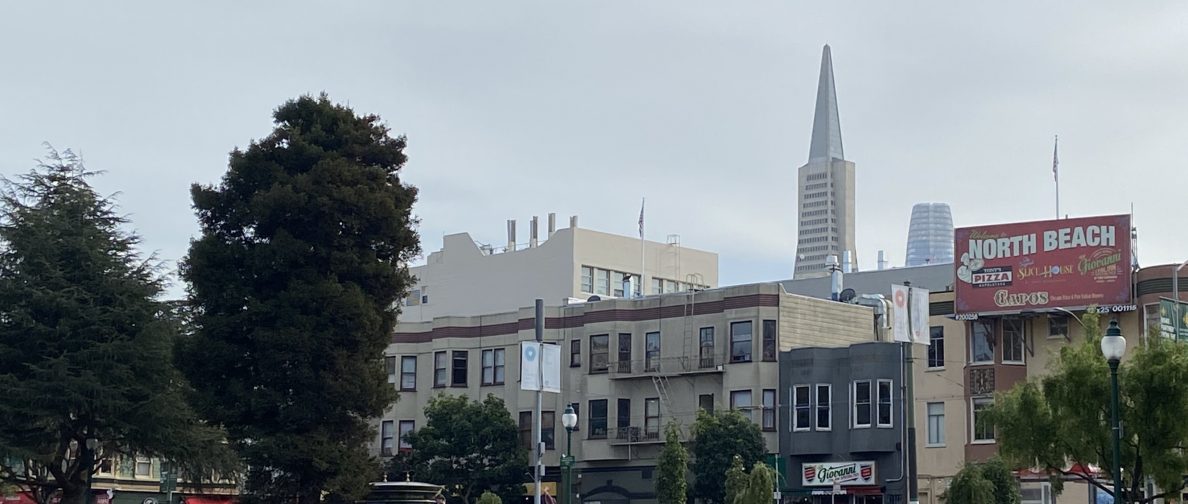
The North Beach District has been predominantly populated by Italians since the 1920’s, according to a historical essay on foundsf.org. The neighborhood is even nicknamed “Little Italy,” and along all light poles of the area, the Italian flag is painted on them. 

In present day, the district is heavily visited by tourists due to the famous landmarks such as Pier 39, Coit Tower, and the Exploratorium. Connie Hirschmugel is a Jehovah’s Witness volunteer that knows the area very well and guides tourists on where to visit. 

“Boudin’s, on the third story, they have a museum up at that place that has been there since 1848, was founded by a man who was very passionate about bread making… He didn’t just take flour and put yeast in it. He kept the mother starter, so every loaf of bread made after that, he saved the mother starter which has bacteria in it, ” Hirschmugel explained. She also said that she could tell that the bakers in Boudin’s love making the bread.

She spoke about the multiple free museums that are in the area that are rich with the history of North Beach.

The neighborhood of North Beach falls inside of District 3 in San Francisco, which also includes nearby neighborhoods like North Beach, Chinatown, Fisherman’s Wharf, Polk Gulch, Union Square/Financial District and Russian, Nob and Telegraph Hills. Aaron Peskin is the current supervisor for District 3.

The area, like many of the other neighborhoods within San Francisco, has been slowly raising the rent on its residents and business owners, making it difficult to stay in the area. Annabella Rossetti, a local resident commented on the change that she has seen from growing up in the area.

“Gentrification has changed the dynamic of people living here now… a lot of businesses over time, over tech folks moving in, rent increasing, a lot of people have been forced out,” Rossetti said.

Rossetti later added in, “I just walked by a coffee shop I usually go to, it was so busy. It’s called Beacon and like everyone in there was just on their computer working remotely… Like everyone looked the same.”

Schools that are in the North Beach District include Garfield Elementary School, Francisco Middle School, and Saints Peters and Paul School. Right across from Saints Peters and Paul School is Washington Square, a park that is visited by residents and tourists of the area. A playground was recently renovated and reopened in January of 2019, according to the San Francisco Recreation and Parks website.

Henry Jeger is a resident of North Beach who is joined by his dog, Gus. 

“Lots to do, lots of places to walk around… The things that I like the most are Washington Square Park, Pier 39’s lawn, I like to go up to Coit tower and walk to Ghirardelli Square.”

A few blocks down from Washington Square is another public park called the Joe Maggio Playground that is right next to the North Beach Library and the North Beach Swimming Pool. All of these areas are free and open to the public, minus the swimming pool which is public but does require payment to be used.

Central Police Station, which is located in Russian Hill, is the closest police station to North Beach. According to the crime data for the Central Police Station, just in the first month of this year alone, there have been 641 reported incidents of larceny theft. That is a decrease of reported thefts compared to the 711 thefts in January of 2019.

North Beach has a fire department station right in the middle of the district and nearby Washington Square. This is beneficial since the area is commonly affected by fires. In the matter of nearly 6 months in 2018, there were 3 fires that occurred. 

“Coit Liquors was actually a famous liquor store here, a lot of people would famously go to Coit Liquors because it’s one of the standing businesses that was here for years, they were forced to close,” Rossetti commented. She made claims as to why the fires could be happening. 

“I don’t know if people are purposely doing that to claim insurance money because they can’t afford San Francisco.” 

North Beach is on the quieter side of crime compared to other areas in San Francisco. SFPD uses a system called Compstat in order to “inform our Crime Strategies Unit which is focused on tracking data and strategically deploying resources to significantly reduce violent crimes and property crimes.” By looking at the Compstat data for Central Police Station it can be seen that the great majority of crimes fall under property crimes.